
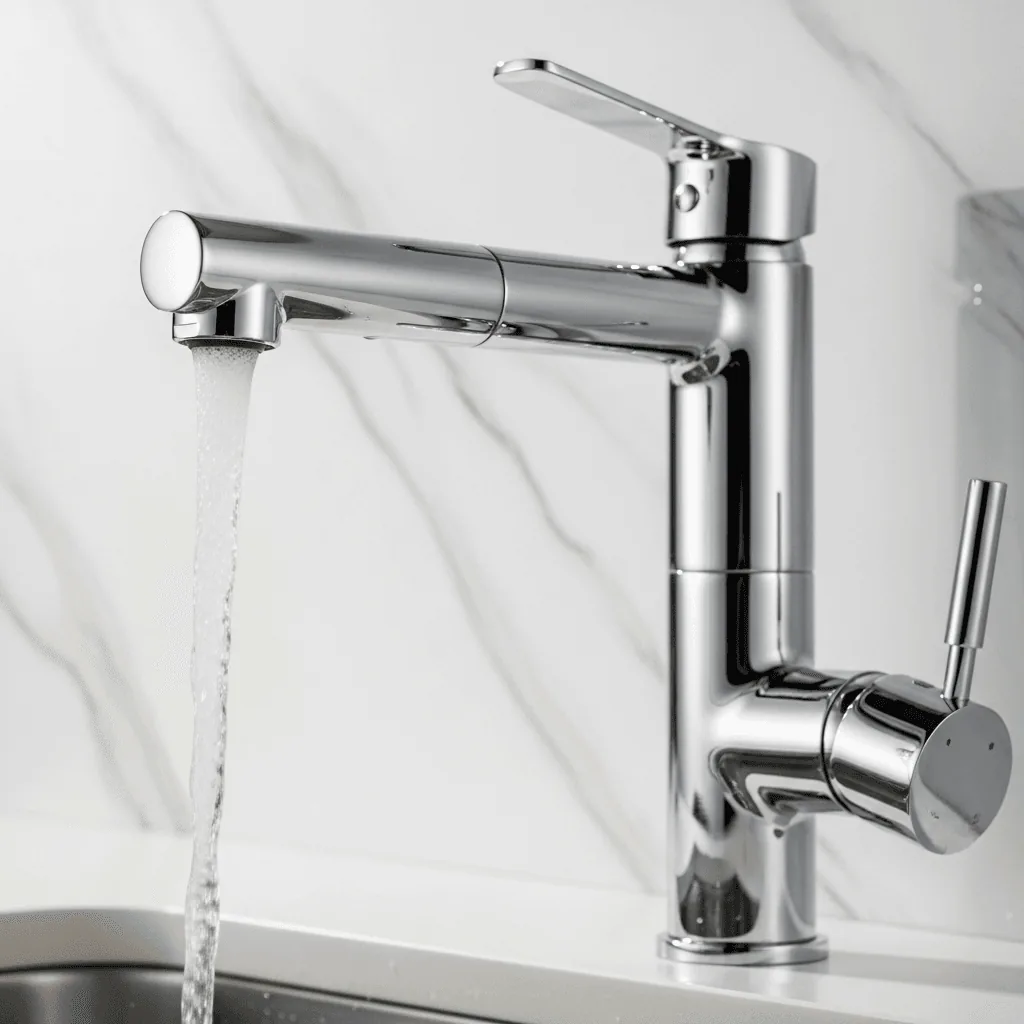
Every winter we get the same call: "The bathroom sinks work fine, but nothing's coming out of the kitchen faucet." It's almost always the kitchen. There's a real reason for that, and it has more to do with where your house was framed than how cold it got last night.
Why the kitchen line is the one that freezes
In most houses built in the last sixty years or so, the kitchen sink sits against an exterior wall. That's where the window goes — homeowners want to look outside while they wash dishes, and builders run with it. The supply lines for hot and cold water then travel up through the wall cavity behind the sink base, or they come up through the floor inside a cabinet that's pressed against that same exterior wall.
Bathroom sinks, by contrast, are often on interior walls — back-to-back with a closet, a hallway, or another bathroom. The pipe runs stay inside the heated envelope of the house, surrounded by warm air on both sides.
That's the whole story in one sentence: kitchen supply lines spend more of their run in cold space than bathroom lines do.
A few specific things make it worse:
- Cabinet boxes act like little insulated boxes — but on the wrong side. The closed cabinet door keeps the warm room air out of the cavity where the pipes live.
- Sink bases often have a gap or knockout at the back where the supply lines come through. Cold air from the wall cavity sneaks into that cabinet and pools around the shutoff valves.
- Under-sink cabinets are usually on an outside corner of the house — two exterior walls meeting — which is the coldest spot in any room.
- Insulation behind a sink base is frequently thin or missing. Plumbers ran the lines, drywall went up, and nobody ever stuffed batt insulation back in around the pipes.
So when a cold snap rolls through Bucks or Montgomery County and the wind is hitting the north or west side of the house, the kitchen line is the first one to drop below freezing. Hot side often freezes before cold, too, because hot water holds less dissolved gas and the pipe is usually copper running a longer path from the water heater.
How freezing actually breaks a pipe
Water expanding into ice doesn't usually split the pipe at the ice itself. What breaks the pipe is pressure trapped between the ice plug and a closed faucet. As more water freezes, pressure builds in the liquid section with nowhere to go, and the pipe ruptures — often several feet away from the actual frozen spot, sometimes in a wall you can't see.
That's why the standard advice is to let a faucet drip during a hard freeze. A dripping faucet relieves pressure. It doesn't keep the pipe warm; it just gives the water somewhere to go so the line doesn't burst. The American Red Cross and most utilities recommend a pencil-lead-thin stream from both the hot and cold sides on any faucet served by a line that runs through an exterior wall.
The cabinet-door trick (and why it works)
Here's the one that actually moves the needle: open the cabinet doors under the kitchen sink when temperatures drop into the teens or lower.
It sounds like folk wisdom, but the physics is real. Your house is heated to somewhere around 68\u201372\u00b0F. The inside of a closed sink base on an exterior wall, with a cold-air leak around the pipe penetrations, can sit twenty or thirty degrees colder than the room it's in. Opening the doors lets that warm room air circulate against the back of the cabinet and around the supply stops. We've stuck thermometers in sink bases on 10\u00b0F nights and watched the cabinet interior climb from the high 30s to the low 60s within an hour of opening the doors.
Two notes if you try this:
- Move anything dangerous out of the cabinet first \u2014 dish soap is fine, but if you store drain cleaner, oven cleaner, or anything with kids or pets in the house, get it out before you prop the doors open.
- Don't bother on a 28\u00b0F night. This is a sub-20\u00b0F trick. Above that, your pipes are almost certainly fine if the heat is running.
Other things that actually help
In rough order of effort and effectiveness:
- Keep the heat on, even if you're away. Don't set the thermostat below 55\u00b0F when you travel in winter. The savings aren't worth a burst pipe.
- Disconnect garden hoses in the fall. A hose left attached holds water in the outdoor spigot, and that ice can travel back into the wall.
- Insulate the supply lines you can reach. Foam pipe sleeves from any hardware store, slit lengthwise, slide right over the lines under the sink. Tape the seam.
- Seal cold-air leaks into the cabinet. Spray foam or caulk around the holes where the supply lines and drain come through the cabinet back. This is the single biggest improvement most kitchens are missing.
- Know where your main shutoff is. If a pipe does burst, the minutes between discovery and shutoff are what determine whether you're mopping or calling a restoration company.
The Department of Energy has good general guidance on pipe insulation in unconditioned spaces, and it applies to cabinet interiors that behave like unconditioned spaces in a cold snap.
If the faucet is already frozen
Don't panic, and don't reach for a torch. Open the faucet (both handles) so water has somewhere to go when the ice melts. Warm the area with a hair dryer, a space heater aimed into the cabinet, or hot rags wrapped around the visible supply lines. Work from the faucet back toward the wall \u2014 you want the melt water to be able to escape out the open spout, not get trapped behind more ice.
If no water comes back after thirty or forty minutes of warming, or if you see any sign of a wet wall, ceiling, or floor below the kitchen, shut the water off at the main and call a plumber. A pipe that froze and burst behind drywall won't show its damage until the ice thaws and the water starts flowing again.
When a swap actually helps
Replacing the faucet doesn't fix a freezing problem \u2014 the lines in the wall are the issue, not the fixture. But if your kitchen faucet is old enough that the shutoff valves under the sink are seized, that's worth addressing before winter, not during. A stuck stop valve when you need to isolate a leak is the kind of small thing that turns a manageable problem into a flooded kitchen.
If your under-sink shutoffs are corroded, frozen, or weeping, swapping them along with the supply lines and faucet is a routine job \u2014 one of the swaps we handle regularly around Horsham and the surrounding townships. We work on a flat-rate basis with upfront pricing, and we won't try to talk you into a remodel you didn't ask for.