
Most homeowners know they need smoke detectors. Fewer know that the number, location, and even the distance from a ceiling fan are spelled out in a national code. If you've ever wondered whether the one alarm in your hallway is enough — or why a contractor wants to add four more during a sale — this is what the rules actually say.
The document behind almost every local requirement is NFPA 72, the National Fire Alarm and Signaling Code, published by the National Fire Protection Association. Pennsylvania, including Horsham and the surrounding Bucks and Montgomery County towns, follows it through the state building code. Local AHJs (authorities having jurisdiction — usually your township inspector) can add to it, but they can't subtract from it.
The minimum coverage rule
For a single-family home built or substantially renovated under modern code, NFPA 72 requires smoke alarms in three categories of location:
- Inside every sleeping room. Each bedroom gets its own alarm, period.
- Outside each separate sleeping area, within 21 feet of any bedroom door. In practice this means the hallway that bedrooms open onto.
- On every level of the home, including finished basements and habitable attics. An unfinished basement still counts — put the alarm at the top of the basement stairs.
That last one trips people up in split-levels and bi-levels. A landing halfway between floors isn't a "level" by itself, but a finished bonus room over a garage usually is. When in doubt, more is better — and the code is a floor, not a ceiling.
The other commonly missed location is the top of every stairway, since smoke rises and a stairwell behaves like a chimney. You don't need one at the bottom of the stairs in most layouts, but the top is required.
The "don't put it there" zones
A lot of nuisance alarms come from putting a detector in the wrong spot, not from the detector being bad. NFPA 72 includes minimum distances from things that cause false trips or dead air:
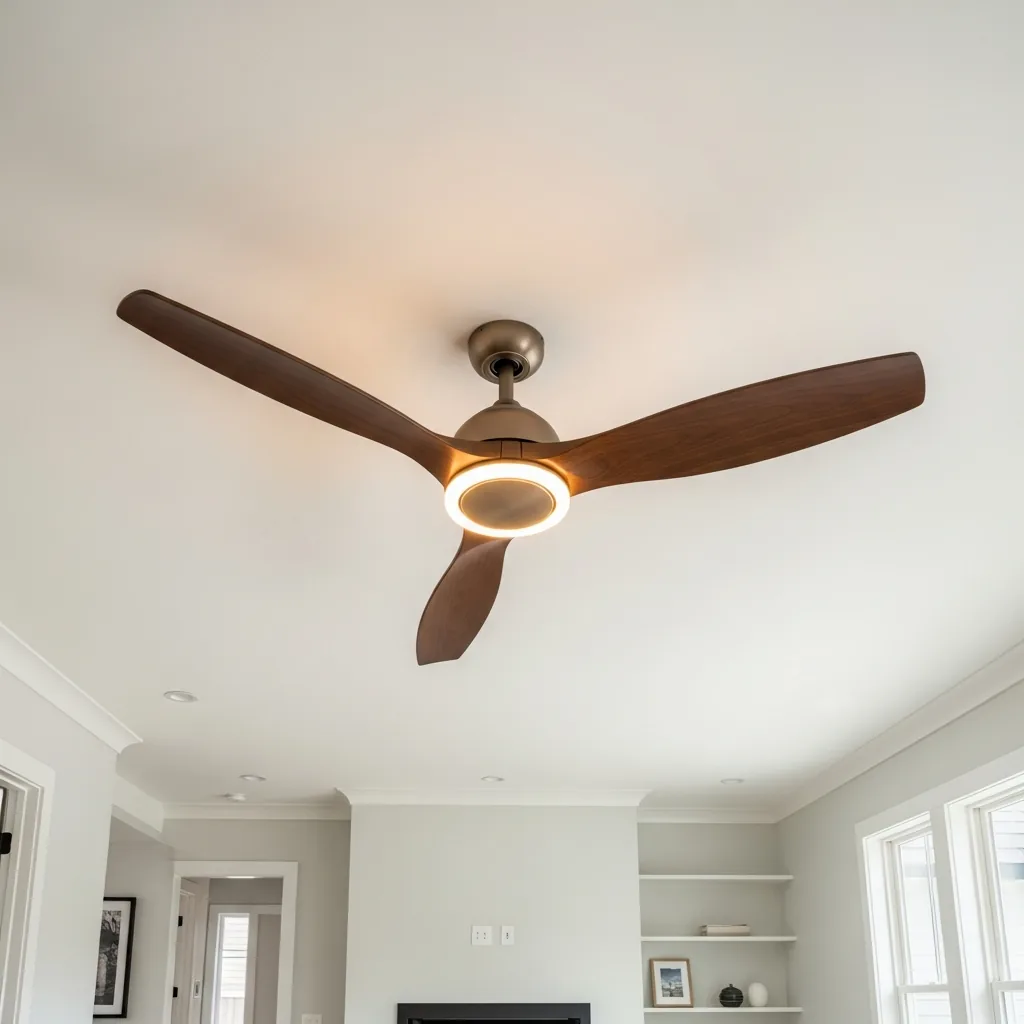
- At least 3 feet from the tip of a ceiling fan blade. Moving air can keep smoke from reaching the sensor and can also stir up dust into it.
- At least 3 feet from any HVAC supply register. Same reason — forced air dilutes smoke at the sensor.
- At least 3 feet from a bathroom door that opens to a tub or shower. Steam reads as smoke to a photoelectric sensor.
- At least 10 feet from a cooking appliance when possible. If the layout makes 10 feet impossible (small condos, galley kitchens), a photoelectric-only alarm is allowed closer, but never directly over the stove.
- Not in the "dead air" corner where a wall meets the ceiling. On a flat ceiling, keep the alarm at least 4 inches off the nearest wall. If you're wall-mounting, the top of the alarm should be 4 to 12 inches down from the ceiling.
- Not on an uninsulated exterior wall or near a window or exterior door, where drafts and temperature swings cause false alarms and missed alarms both.
Vaulted and tray ceilings have their own rule: the alarm goes within 3 feet of the peak, measured horizontally, but not in the apex itself. The NFPA's public education page has plain-language summaries of the current edition if you want to read more.
Hardwired, battery, or both
There are three categories of alarm in residential use:
- Battery-only. A sealed 10-year lithium unit is the current standard. Replaceable 9-volt models are still legal in most existing homes but are being phased out in new construction.
- Hardwired with battery backup. Powered from a dedicated 120V circuit, with a battery that takes over during outages. Required in new construction and most major renovations.
- Wireless interconnected battery. Sealed-battery alarms that talk to each other over RF — useful for retrofits where running wire isn't realistic.
If your home was built after the mid-1990s, you almost certainly have hardwired alarms tied together. When one goes off, they all go off. That's interconnection, and it's a code requirement on new builds because it gives people on the far side of the house enough warning to get out. The U.S. Fire Administration data on home fire deaths consistently shows that working, interconnected alarms cut fatality risk roughly in half — you can read the underlying research on the USFA site.
A few practical points homeowners get wrong:
- You cannot mix hardwired alarms from different manufacturers on the same interconnect loop. The signaling voltages aren't standardized across brands. If you're replacing one, replace the whole loop with the same brand and series, or use compatible models from the same maker.
- Wireless interconnected alarms generally won't talk to hardwired alarms unless you buy a specific bridge module. Pick one system and commit.
- A hardwired alarm still needs its backup battery checked — the whole point of the battery is the 1 a.m. power outage during a storm.
Smoke vs. combination alarms
NFPA 72 also requires carbon monoxide alarms outside each sleeping area in homes with any fuel-burning appliance or an attached garage — which is most homes around here. A combination smoke/CO alarm in the hallway satisfies both rules in one device, and that's what most pros install on a swap.
If you're choosing sensor type: photoelectric sensors respond faster to smoldering fires (couch cushions, electrical insulation), and ionization sensors respond faster to fast-flaming fires (paper, grease). Dual-sensor alarms cover both. Brands like First Alert and Kidde publish their sensor types right on the spec sheet.
When to swap, not just change batteries
The sensing chamber inside every smoke alarm degrades over time. Both NFPA and every major manufacturer say the same thing:
- Replace the entire alarm every 10 years from the date of manufacture (printed on the back, not the install date).
- Replace immediately if it chirps after a fresh battery, fails its test button, or has visible yellowing or water staining.
- Replace the whole loop together when one ages out — they were all installed the same week and they're all on the same clock.
If you bought a house and you're not sure how old the alarms are, flip one off the ceiling and check the date stamp. Anything over 10 years old is past due regardless of whether it still beeps.
Quick homeowner checklist
Walk your house and confirm:
- One alarm inside every bedroom
- One in the hallway outside the bedrooms
- One on every floor, including the basement
- One at the top of every staircase
- All at least 3 feet from fans, vents, and bathroom doors
- All less than 10 years old
- All interconnected if the home was built or rewired after the mid-90s
If you're missing alarms in required spots and the wiring is already in the ceiling box, that's a straightforward swap. Replacing a whole interconnected set with a matched modern series is the kind of small electrical job we handle on a same-day basis — pricing is flat-rate up front, no per-device surprises. If the boxes aren't there yet, that's new wiring and you'll want a full-service electrician for that part first.